

 English
 русский
 Español
 简体中文
简体中文

Hex Flange Bolt
Bolts are indispensable fasteners in industrial manufacturing, machinery equipment, automotive assembly, and construction engineering. Among them, hex flange bolts, with their unique flange structure, enhance both fastening strength and resistance to loosening, making them a widely used standard fastener.
This article will detail the characteristics, specifications, manufacturing process, and application scenarios of hex flange bolts to help you better understand their advantages and key selection points.
What is a hex flange bolt?
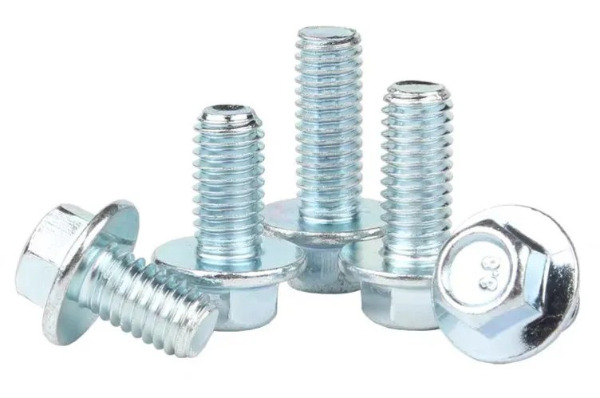
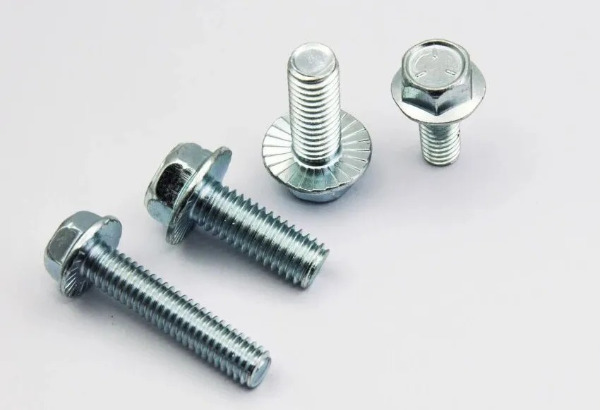
A hex flange bolt is a type of bolt with a hex head and a flange. Its head has an extended flange face, similar to an integrated design of the bolt head and washer. This structure increases the contact area, reduces localized stress, and improves resistance to loosening, making it particularly suitable for high-vibration or high-load conditions.
Hex flange bolts typically conform to standards such as GB/T 5787 (Chinese Standard), DIN 6921 (German Standard), ISO 1665 (International Standard), and ASME B18.2.1 (American Standard), and are widely used in machinery, automotive, and steel structure construction.
Features of Hex Flange Bolts
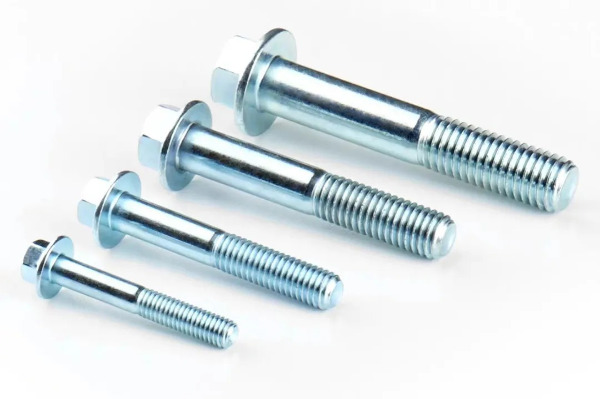
• Flange face design for improved stress distribution:
The flange face is equivalent to a built-in washer, increasing the stress-bearing area and reducing deformation and damage to the connected parts.
Uniform stress distribution improves the bolt's load-bearing capacity, making it suitable for fastening connections of different materials such as metals and plastics.
• Superior Anti-Loosening Performance:
Standard Flange Bolts: Flat flange surface, suitable for general mechanical structures, with slightly better anti-loosening performance than ordinary hex bolts.
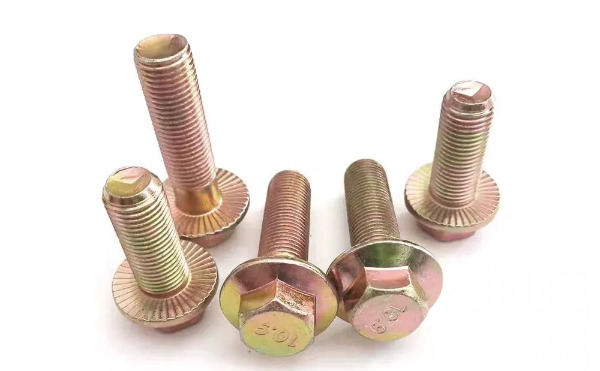
Nose-Coated Flange Bolts: Flange surface with radial anti-slip teeth, providing stronger anti-loosening effect, widely used in high-vibration conditions, such as automotive engines and transmissions.
• Rich Strength Grades to Adapt to Different Load Requirements:
4.8 Grade: Suitable for low-strength fastening requirements, such as home assembly and light machinery.
8.8 Grade: High strength and durability, suitable for automotive, construction machinery, and other fields.
10.9 Grade: High strength level, suitable for structures subjected to large loads and vibrations.
12.9 Grade: Ultra-high strength flange bolts, mostly used in high-precision machinery, aerospace, and other high-end industrial fields.
• Hex Flange Bolt Materials:
Carbon Steel (e.g., 35#, 45# steel): Suitable for general mechanical connections.
Alloy Steel (e.g., 40Cr, 42CrMo): Possesses higher tensile strength and fatigue resistance. Stainless steel (e.g., 304, 316 stainless steel): Highly corrosion resistant, suitable for outdoor, humid environments, or the chemical industry.
• Surface treatments:
Zinc Plating: Enhances oxidation resistance, suitable for general industrial applications.
Hot-Dip Galvanizing: Provides a thicker corrosion-resistant layer, suitable for outdoor steel structures or marine environments.
Dacromet: Highly resistant to salt spray corrosion, widely used in automotive fasteners.
Black Oxide: Enhances wear resistance, suitable for precision machinery or military equipment.
Hex flange bolt manufacturing process
1. Material Preparation: Select appropriate materials based on bolt specifications, such as carbon steel, stainless steel, or alloy steel, and cut them accordingly.
2. Cold Heading: Use a high-precision cold heading machine to machine the bolt heads, forming the flange and hex head in one step, ensuring dimensional accuracy and mechanical properties.
3. Turning (Optional): For flange bolts requiring high precision, additional turning processes can be performed to improve surface finish and dimensional accuracy.
4. Thread Rolling: Use thread rolling technology to manufacture threads, improving thread strength and durability and avoiding material damage that may occur during machining.
5. Heat Treatment: Quench and temper high-strength bolts of grade 8.8 and above to improve hardness and tensile strength, making them suitable for high-load environments.
6. Surface Treatment: Galvanize, hot-dip galvanize, Dacromet, or other anti-corrosion treatments according to customer requirements to enhance bolt durability and environmental adaptability.
7. Quality Inspection; Dimensional Inspection: Use thread gauges, calipers, and other tools to inspect key dimensions of the bolts, such as length, diameter, and pitch.
Mechanical Performance Testing: Conduct tensile, impact, and hardness tests to ensure compliance with standard requirements.
Corrosion Resistance Testing: Such as salt spray testing, to evaluate the bolts' corrosion resistance.
Determine load requirements: Select the appropriate strength grade based on the load-bearing capacity, such as grade 8.8, 10.9, or 12.9.
Consider anti-loosening requirements: For high-vibration environments, toothed flange bolts are recommended.
Match the working environment: For humid or corrosive environments, use stainless steel bolts or bolts with special anti-corrosion treatment.
Reference standards: Prioritize bolts conforming to ISO, DIN, or ASME standards to ensure quality stability and interchangeability.
Hex flange bolts, with their unique structural design, excellent anti-loosening performance, and wide range of applications, have become an indispensable standard fastener in the industrial field. Choosing the appropriate specifications, strength, and surface treatment not only improves assembly efficiency but also ensures long-term reliability and safety.
If your project requires high-strength, anti-loosening fasteners, hex flange bolts are undoubtedly a reliable choice.
Welcome to consult the Jiangxin team!