

 English
 русский
 Español
 简体中文
简体中文

Carriage Bolts
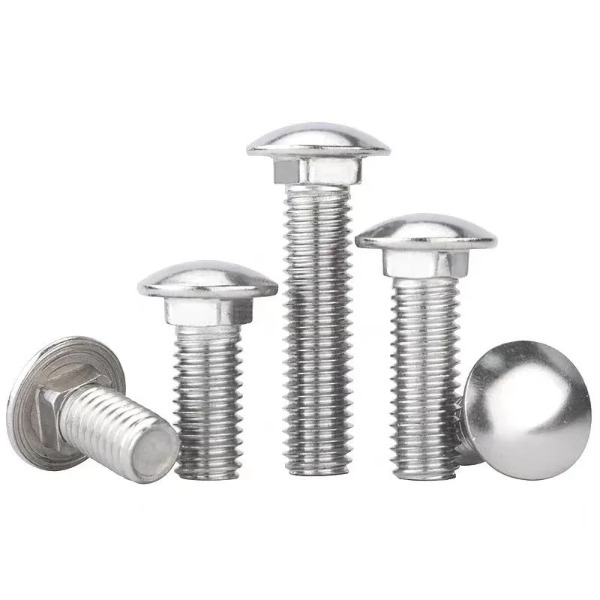
What are Carriage Bolts?
Carriage bolts excel in many applications thanks to their unique structure and anti-rotation design. Their diverse material choices and surface treatments allow them to adapt to different environments and requirements. Structurally, the round head and square neck designs are both aesthetically pleasing and highly functional; in terms of materials and surface treatments, different choices can significantly improve bolt performance and service life. Through appropriate material selection and surface treatment, carriage bolts can provide reliable connection solutions under various harsh conditions and are widely used in construction, machinery manufacturing, furniture assembly, and other fields.
Structural features of carriage bolts
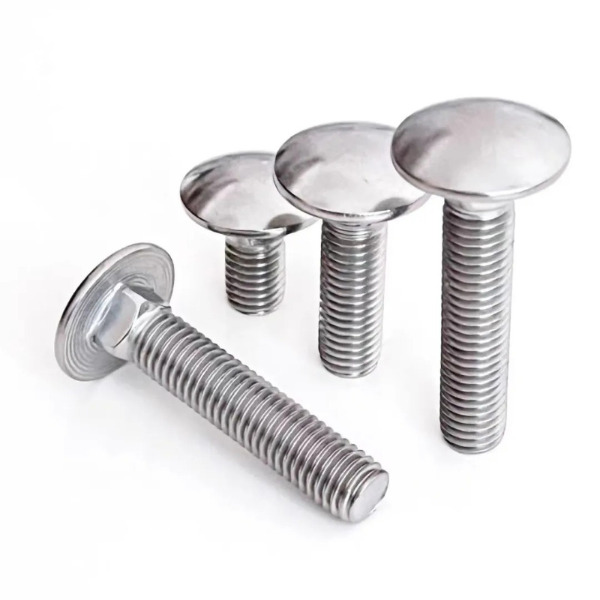
Rounded Head:
Carriage bolts typically have semi-circular heads, available in large and small semi-circular shapes, corresponding to standards GB/T14 and GB/T12-85 respectively. This shape distributes pressure, reduces stress concentration at the connection, and the absence of exposed edges prevents scratching or snagging on surrounding objects, making it suitable for applications where appearance and safety are paramount.
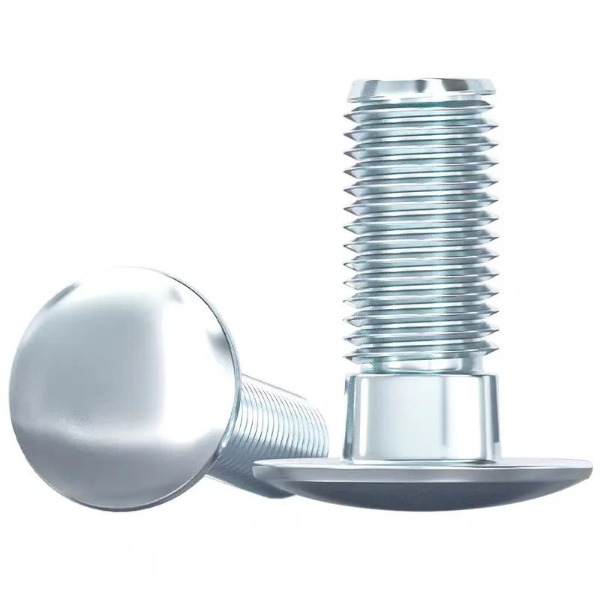
Square Neck:
A square neck is an important characteristic of carriage bolts, located below the head. The square neck allows it to engage with the square hole or groove of the mating component during installation, preventing the bolt from rotating and thus enhancing the stability and reliability of the bolted connection.
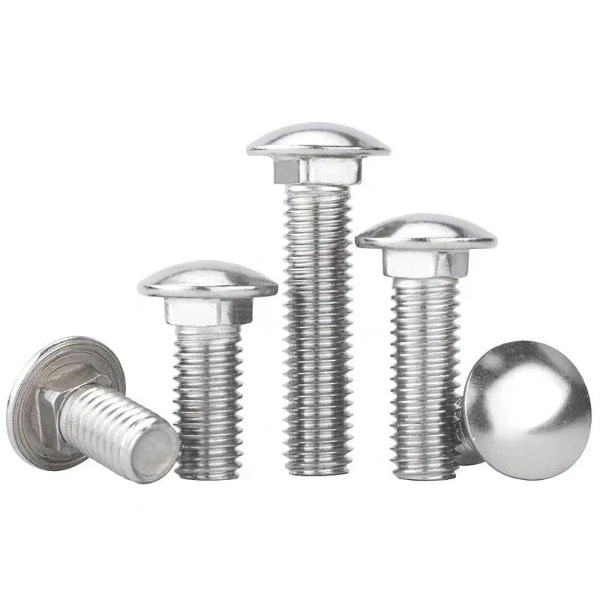
Threaded Stem:
The threaded stem has external threads and can be used with a nut to achieve a fastening connection between two or more components. Threaded stems are available in both fully threaded and partially threaded forms, allowing selection based on different fastening requirements.
Standard for carriage bolts
The standards for carriage bolts vary considerably by country and region. Common standards include Chinese national standards, German standards, international standards, and American standards. Different standards correspond to different head styles, dimensions, and other characteristics of the bolts, adapting to different application scenarios. The following is a detailed introduction:
1. Chinese National Standard (GB)
GB/T12-2013: Corresponds to small semi-circular head square neck carriage bolts, also called small-head high-cap carriage bolts. This standard specifies parameters such as pitch, bolt length, and head size for different thread specifications (e.g., M6-M20). The thread tolerance is mostly 8g, and the mechanical performance grades cover 4.6, 4.8, etc., commonly used in scenarios where head size requirements are not high.
GB/T14: Corresponds to large semi-circular head carriage bolts, also known as large-head carriage bolts. Its head size is larger than the GB/T12 series, but the head thickness is relatively smaller. It is suitable for fastening scenarios where a certain head bearing area is required, often used with nuts for connecting iron and wood structures and mechanical components.
GB794: For high-strength semi-circular head square neck bolts, belonging to the reinforced carriage bolt category. Its performance grades can reach 8.8, 10.9, and 12.9. It is usually tempered, and the surface is mostly black oxide, but galvanizing is also possible upon request. It is suitable for applications requiring high bolt strength.
2. German Standard (DIN)
DIN603: This is a commonly used standard for exported carriage bolts, corresponding to large semi-circular head square neck bolts. Compared to the Chinese GB/T14 standard, it has a larger head, a lower square neck height, metric threads, and is mostly made of carbon steel or stainless steel. Surface treatments include black oxide and galvanizing. This standard clearly specifies the dimensional tolerances and mechanical properties of the bolts and is applicable to railway vehicles, mining equipment, and other fields.
3. International Standards (ISO)
ISO 8677: Specifies the dimensions, tolerances, and performance requirements for metric carriage bolts. Compared to some national standards, it does not restrict the specific shape of the hexagonal head of the bolt, only specifying the dimensions and tolerances of the square neck, adapting to internationally common mechanical equipment fastening scenarios.
ISO 8678: For small semi-circular head, low square neck bolts, it belongs to a special specification of carriage bolt standard, mostly used for customized mechanical connection needs.
4. Other Regional Standards
ANSI/ASME B18.5: American carriage bolt standard, differing significantly from metric standards. Its thread specifications follow American standards, and parameters such as nut size and square neck height also differ from national and German standards. It mainly adapts to the fastening needs of equipment, construction, and other fields in the North American market.
BS 325: British standard, corresponding to coarse semi-circular head square neck bolts; BS 4933 is the metric large semi-circular head carriage bolt standard. These two standards are commonly used in the manufacture and maintenance of related equipment in Commonwealth countries.
JIS B1171: Japanese standard for grooved square neck bolts, a derivative specification of carriage bolts, suitable for connecting components in textile machinery, agricultural equipment, etc. in Japan.
Surface Treatment of Carriage Bolts
The core purpose of surface treatment for carriage bolts is rust and corrosion prevention, improved appearance, or enhanced wear resistance. Common types can be categorized into three types based on function: basic rust prevention, enhanced protection, and special needs, as follows:
Basic Rust Prevention (Low Cost, General Applications)
Oxidation Blackening: Forms a black oxide film on the surface through chemical oxidation. Low cost and simple process.
Only provides slight rust prevention and requires the use of rust-preventive oil. Suitable for dry, non-corrosive indoor environments, such as internal connections in ordinary machinery.
Electro-galvanizing (White Zinc / Blue-White Zinc / Color Zinc): Deposits a zinc layer on the bolt surface. Better protection than blackening.
White zinc has a silvery-white appearance, blue-white zinc is brighter, and color zinc (after passivation) offers stronger rust prevention. Suitable for humid, mildly corrosive indoor environments, such as furniture and door/window connections.
Enhanced Protection (Outdoor, Corrosive Environments)
Hot-Dip Galvanizing: Immerses the bolt in molten zinc to form a thicker zinc layer. Strong rust prevention and good durability.
Silver-gray appearance: Suitable for outdoor, open-air, or acid/alkali environments, such as building steel structures, railings, and agricultural machinery.
Dacromet (Zinc-Chromium Coating): A coating primarily composed of zinc powder and chromate, it eliminates the risk of hydrogen embrittlement and offers excellent salt spray resistance. Its silver-gray appearance makes it suitable for high-strength bolts, marine environments, or scenarios requiring no hydrogen embrittlement, such as shipbuilding and chemical equipment.
Special Functional Applications (Wear Resistance, Conductivity, etc.)
Nickel/Copper Plating: Nickel plating results in a bright surface, combining wear resistance and aesthetics; copper plating is primarily used for conductivity or as a base coat for subsequent plating layers.
Suitable for electronic equipment, precision machinery, or applications where appearance is important, such as fasteners in instruments and meters.
Phosphating Treatment: Forms a phosphate film, primarily used to enhance the adhesion of bolts to coatings and paints, or as a lubricating base coat. Often used as a pretreatment process in conjunction with painting, suitable for structural connections requiring subsequent painting.
Carriage bolts, with their unique structural design, excellent anti-loosening performance, and wide range of applications, have become an indispensable standard fastener in the industrial field. Choosing the appropriate specifications, strength, and surface treatment not only improves assembly efficiency but also ensures long-term reliability and safety.
If your project requires high-strength, anti-loosening fasteners, carriage bolts are undoubtedly a reliable choice.
Welcome to contact the Jiangxin team!