

 English
 русский
 Español
 简体中文
简体中文

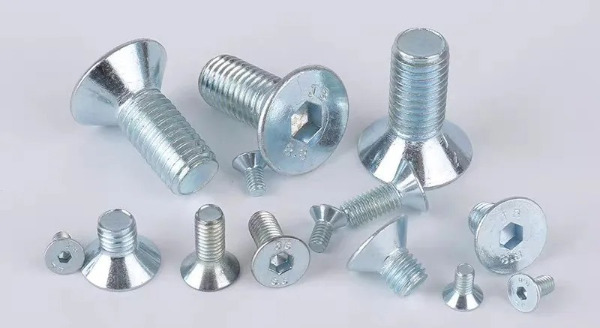
Flat Head Hex Socket Bolt
A flat head hex socket bolt is a fastener with a 90° tapered head. The screw head fully embeds into the workpiece surface, remaining flat after installation without protrusion. It features an aesthetically pleasing appearance, anti-snagging properties, and even force distribution.
Its head has an internal hex socket, allowing for tightening or loosening with an Allen wrench. It provides higher torque transmission capacity than traditional Phillips head countersunk screws, making it more suitable for high-strength fastening applications.
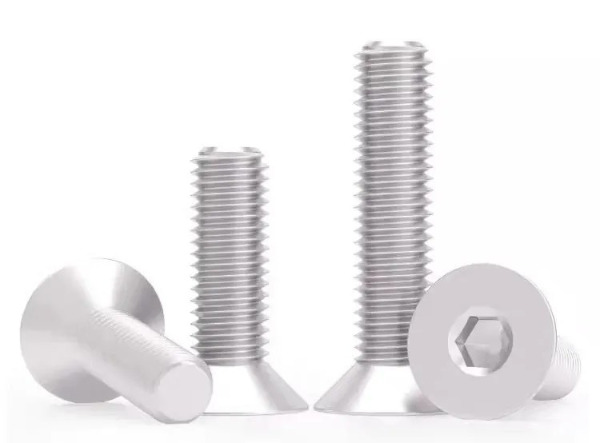
Structural Features of the Flat Head Hex Socket Bolt
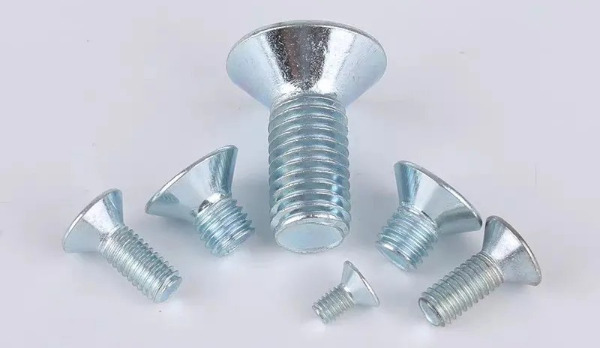
90° Tapered Head – Flushes with the workpiece surface after installation, enhancing aesthetics and safety.
Internal Hex Drive – Strong torque transmission capability, suitable for high-strength fastening.
Partial or Full Threaded Rod – Adapts to different application needs (full thread enhances locking force, partial thread improves connection stability).
Multiple Material Options – From standard carbon steel to high-strength alloy steel, stainless steel, or titanium alloy, meeting diverse working conditions.
Optional Surface Treatments – Blackening, electroplating, Dacromet coating, anodizing, etc., improving corrosion resistance and wear resistance.
The Industry Standard for Flat Head Hex Socket Bolts
ISO 10642 – International standard for flat head hex socket bolts, specifying metric dimensions and tolerances.
GB/T 70.1 – Chinese national standard, covering the specifications and performance of metric flat head hex socket bolts.
DIN 7991 – German standard, applicable to high-strength countersunk bolts in the machinery and mold industries.
ANSI/ASME B18.3 – American standard, applicable to imperial countersunk bolts.
Manufacturing of Flat Head Hex Socket Bolt
Raw Material Selection
• Carbon Steel (Grade 4.8/8.8/10.9/12.9) – Suitable for mechanical structures and general equipment.
• Stainless Steel (304/316) – Suitable for corrosion-resistant environments, such as outdoor and chemical equipment.
• Alloy Steel (42CrMo, SCM435) – Suitable for high-strength, impact-resistant applications, such as automotive and machine tools.
• Titanium Alloy (TC4) – Suitable for lightweight and high-end applications, such as aerospace and medical equipment.
Cold Heading
• One-time cold heading using a multi-station machine ensures seamless integration of the head and shank, improving bolt strength.
Tuning & Threading
• Precision CNC turning ensures accurate head angles and dimensional tolerances. Threads are rolled to improve surface finish and fatigue resistance.
Heat Treatment
• Quenching and tempering (quenching + tempering): Improves strength and toughness, suitable for bolts of grade 8.8 and above. Solution treatment: Used for stainless steel bolts to improve corrosion resistance.
Surface Treatment
• Blackening: Enhances rust resistance, suitable for indoor equipment.
• Zinc plating (blue-white zinc/color zinc/black zinc): Suitable for machinery with general corrosion resistance requirements.
• Dacromet coating: Strong salt spray resistance, suitable for long-term outdoor environments such as automobiles and bridges.
• Oxidation treatment: Improves the high-temperature resistance and corrosion resistance of bolts.
• PVD coating (for titanium alloys): Enhances wear resistance and reduces the coefficient of friction.
1. Choosing the Appropriate Material
General Equipment: Carbon steel (8.8/10.9 grade) + galvanized or blackened.
High Strength Requirements: Alloy steel (12.9 grade) + tempered.
Corrosion Resistance Requirements: 304/316 stainless steel + polished or Dacromet coating.
Lightweight Requirements: Titanium alloy + PVD coating.
2. Choosing the Appropriate Specifications
Determine the head angle, thread size, and length according to ISO 10642 / GB 70.1 / DIN 7991.
Choose full thread or partial thread to meet different installation requirements.
3. Determining the Surface Treatment
Indoor Environment: Blackened, electroplated zinc.
Outdoor Environment: Dacromet, electroplated nickel.
High Temperature Conditions: PVD coating or anodizing.
Flat Head Hex Socket Bolts, with their advantages of high torque, flat installation, aesthetics, and safety, occupy an important position in fields such as machinery manufacturing, automotive industry, and mold processing.
When selecting one, optimal fastening performance and durability should be ensured based on strength requirements, environmental factors, and surface treatment methods.